Out of the silence
Imagine not being able to speak any language at all. It would mean having thoughts and ideas but no words to share them, no bridge to others. How isolated would we feel without the ability to express ourselves to others, not able to say thank you or ask for help. It’s a silence that may be difficult to imagine, and yet it is the starting point of every new language we learn, even our mother tongue.
Regarding learning a new language, after learning our own, I remember it being in three different Manners of approach.
A) The old way was more focused on grammar, correctness, and memorization.
B) The new way plays with more focus on interactive communication, expression and more real-world use.
C) The ideal balance is that one develops fluency in both of the above, resulting in structure and spontaneous interaction.
A new silence
When I came to Finland I was faced with learning a new language that had no comparison to any of the other languages I knew at that time. Although I had no knowledge of a beautiful Finnish word back then, my learning method was based on that particular word and its “message of reciprocity”. I found that through listening to others and responding to them, finding meaning and placing less emphasis on trying to master the grammar, I was learning quite quickly. We were taking turns and noticing the effect of our words on each other. And in the beginning, this was enough, this was giving me the vocabulary, the interaction, and the courage to communicate in the new and difficult language.
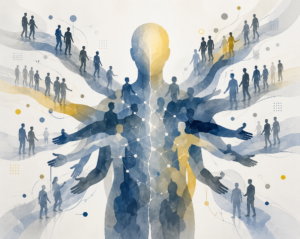
The beautiful Finnish word, (that I learned much later), is “vuorovaikutus”. This word could be translated simply as “interaction,” but that falls short of the word’s true depth and expressiveness. I learned to split the (Finnish compound word) back into two individual words. In English this gave me: (vuoro) turn and (vaikutus) effect/impact. And so, suddenly we are taking turns and we are noticing the effect our words have on each other like in a “my turn your turn situation” which creates awareness of the shared and inclusive process of communication.
To metaphorically expand on the idea of “turn and impact”, think about playing the piano. You press the keys which is your turn, and the sound that follows is the impact. If you have an audience, the sound creates an impact on them, too. At The very beginning, when you press the keys it’s easy to produce only noise. Only through practice does our noise begin to sound like music. With more practice, repetition and focused learning does our playing become more refined and beautiful. Our “turn and impact” have finally become “Beethovenesque”. This way of thinking, this “theory of turn and impact” can be applied to many different areas of life and achievement, but for me, it was first and most clearly visible in my development of language skills.
The individual dimension
Surely the initial and most conclusive application of our “turn and impact” concept begins with the individual. How much is achieved depends on the learner’s interest and motivation, desire and passion, discipline and priorities, and personal choice and responsibility.
Some learning is more compulsory and externally applied, while other learning is based on individual choice and commitment to achievement. In both cases we are able to consider the personal role of “turn and impact”. We are given the opportunity to learn for general knowledge and professional aptitude, and of course, hobbies and chosen pastimes offer a more personal space to experience our own “turn and impact”.
At the same time, the availability and quality of pedagogy, training and coaching play a crucial role in creating a strong foundation for learning. Careeria is dedicated to providing the best possible platform to ensure a meaningful and lasting “turn and impact” within vocational education and the working world.
How do you create your own turn and impact fluency?
Michael Dredge
Teacher
Careeria